
Newspaper cleared over story about self-confessed schoolboy 'fascist'
Pupil quoted Hitler in school leavers' yearbook
A newspaper which highlighted the case of a schoolboy who openly described himself as a "fascist" has been cleared of wrongdoing following a complaint by the boy's father.
In a story headlined 'School rocked by teen's Nazi tribute,' the Belfast Telegraph reported on an entry in a school yearbook in which the youth had described himself as "British, Loyalist and Fascist" and quoted from Adolf Hitler's autobiography Mein Kampf.
It sparked a complaint by the boy's father, who claimed that in portraying his son as a 'Nazi,' the Bel Tel had breached breached Clause 1 (Accuracy), Clause 2 (Privacy) and Clause 3 (Harassment) of the Editors’ Code of Practice.
However the Independent Press Standards Organisation rejected the complaint saying the newspaper had been entitled to interpret the boy's comments as such.
The yearbook from which the comments were taken was made up of short biographies of school leavers written by themselves.
The Bel Tel report, which named the school but not the boy, published a pixellated image of him alongside quotes from Mein Kampf and a 'confession' to having taken part in the so-called Munich 'Bierkeller' putsch of 1923 in which Hitler attempted to seize power.
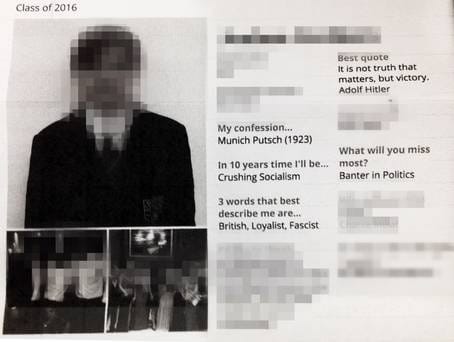
The boy's father said the book had been written for pupils in his son's year group at the school, were not intended for wider distribution and contained "in-jokes" written in a light-hearted manner.
He added that the "banter" in his son’s politics class was the context for the yearbook entry, and that by taking the yearbook entry out of its context and ignoring its humorous nature the newspaper had inaccurately portrayed his son as a neo-Nazi.
Furthermore, he said it was normal for his son to quote historical figures in his academic work and that quoting figures such as Hitler does not mean he subscribed to their ideology.
However the Bel Tel said that the yearbook had been distributed to at least 100 students and would have been read by countless other individuals once it entered the public domain.
In this respect, the newspaper said there was a public interest in informing the public about the matter, adding that it had always devoted considerable coverage to education issues.
The paper further denied that the article was inaccurate, adding there had never been any dispute about the contents of the complainant’s son’s yearbook entry.
IPSO acknowledged the complainant’s position that these were ‘in-jokes’, but they had been written these comments for publication in a yearbook which could be expected to be read without the benefit of that context.
It ruled that the newspaper was entitled to interpret the complainant’s son’s yearbook entry from an external point of view, and it was clear from the article that it was doing so.
The complaint was not upheld, and the full adjudication can be read here.



