
Regional daily's reporters barred from police misconduct hearing
Editor hits out after detective inspector's hearing held in private

A regional daily editor has hit out after reporters from the title were prevented from attending a police misconduct hearing involving a senior police officer.
The Derby Telegraph reported on Wednesday that Detective Inspector Tony Brittan had been dismissed from Derbyshire Police for gross misconduct.
But the paper could not tell readers any details of the allegations because the hearing was held in private - despite new rules which mean such cases should be held in public.
New Home Office rules, which came into force on 1 May, said that police disciplinary hearing must be held in public in a move which was backed by trade body the News Media Association.
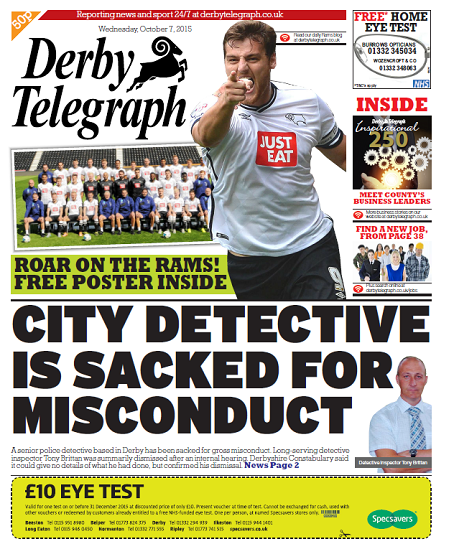
However, the legislation also allows the chair of a disciplinary panel to exclude people from such hearings and also to not advertise when and where they will take place.
Telegraph editor Neil White, pictured above, said the paper's reporters regularly asked for details of when the hearing would take place but were eventually told it had already been held in private.
He wrote in an editorial: "This newspaper's expectation was that we would be able to report Mr Brittan's case in full. We had heard about his impropriety six weeks ago and were, therefore, aware that a hearing was due to take place.
"Our reporters regularly asked of its date and venue but were finally told that it had already been held in private at the instruction of the hearing's chairman, Avon & Somerset deputy chief constable Louisa Rolfe.
"Her decision was made without the opportunity for us to appeal.
"In our view, it defeats the spirit of the Home Office drive for transparency if a senior police office has the power to decide that the public can be barred from such hearings without giving reasons in advance."
The paper was told by Derbyshire Police that a detective inspector admitted gross misconduct and was dismissed, while a detective constable was found guilty of gross misconduct and given a final warning.
Neil told HTFP: "We are aware of the nature of the case thanks to an anonymous call we received weeks ago.
"This meant we understood certain sensitivities and would have accepted orders surrounding them. But we still believe the hearing should have been heard in public.
"We would now hope the system should be changed so we are warned in advance of a proposed media ban and can attempt to influence such a decision."
A spokeswoman for Derbyshire Police told the Telegraph: "Under new legislation, the chair of any misconduct panel has the authority to conduct a hearing in private if he or she feels that there is a compelling reason to do so.
"The chair of this panel, who is from another force, made the decision that this hearing should not be advertised and should be held in private. Derbyshire Constabulary is not able to question or challenge that independent decision."



