
Professor accuses newspaper of 'conflict journalism' over IRA story
Newspaper reported on appearance by Martin McGuinness at conference for conflict victims and survivors
A university professor has accused a regional daily of practising "conflict journalism at its worst" over a story it ran about former IRA leader Martin McGuinness.
The News Letter, Belfast, carried reaction to an appearance last week by Mr McGuinness at a conference for victims and survivors of conflict in Northern Ireland.
The News Letter spoke to Ann Travers, who heard him speak and whose sister Mary was murdered by the IRA in 1984, who took issue with claims he made to the conference about the UK government hiding files about the past behind "bogus" national security issues.
But John D Brewer, Professor of Post Conflict Studies at Queen’sUniversity in Belfast, tweeted that the News Letter front page on Thursday, pictured below, was "conflict journalism at its worst."
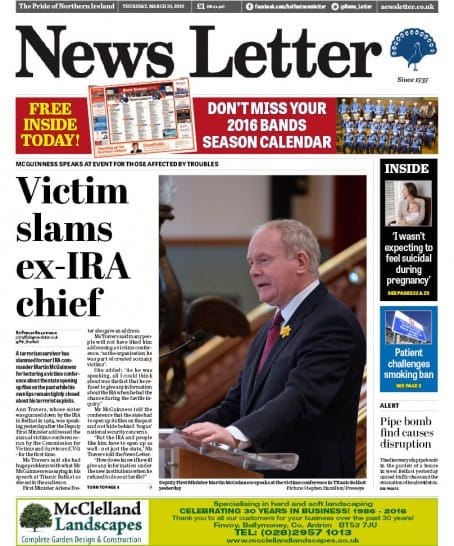
The News Letter has published Professor Brewer's claims, and he continued that "journalists can construct all kinds of stories depending on who it is they rely on as their source."
He also said of Ms Travers, a member of Innocent Victims United which supports 11,500 members, that "no one person represents victims".
Ms Travers had also told the News Letter she took issue with the fact Mr McGuinness refused to give any information on his IRA past to the Saville inquiry into Bloody Sunday, and also with the legal definition of a victim, which "equates terrorists with their victims."
Sinn Fein politician Mr McGuinness is currently Northern Ireland's Deputy First Minister, and served as MP for Mid Ulster in the UK Parliament from 1997 until 2013.
The paper's deputy editor Ben Lowry said: "Professor Brewer is right that there are other ways to describe Mr McGuinness than an ex-IRA commander.
"In the same newspaper, Thursday March 10, we described him as the Deputy First Minister in a story to accompany a cheerful picture of him at the opening of a £4.6 million Mencap facility.
"But the front page victim story was a radically different context. We were referring to Mr McGuinness addressing a victims event, which greatly distressed some victims, where he again demanded full accountability of the UK state."Given the secretiveness or even dishonesty of ex-IRA members, it was appropriate for us to describe Mr McGuinness as an ex-IRA commander in that context."



