
Local newspaper takes on BBC over 'demise of newsagents' piece
Corporation accused of suggesting print is 'obsolete'
A local newspaper has taken the BBC to task over its 'framing' of the narrative on local journalism after a piece on the demise of traditional newsagents.
BBC reporter Kevin Shoesmith wrote an online article headlined 'Why traditional British newsagents are on their last legs' which partly attributed the situation to falling demand for print newspapers.
But the piece, published on the corporation's East Yorkshire channel, went down badly with local newspaper the Holderness and Hornsea Gazette, which claimed it signalled to readers that print is obsolete.
It has now published an open letter raising "serious concerns" about the BBC's framing of the state of the industry, calling it "at best unhelpful, and at worst harmful."
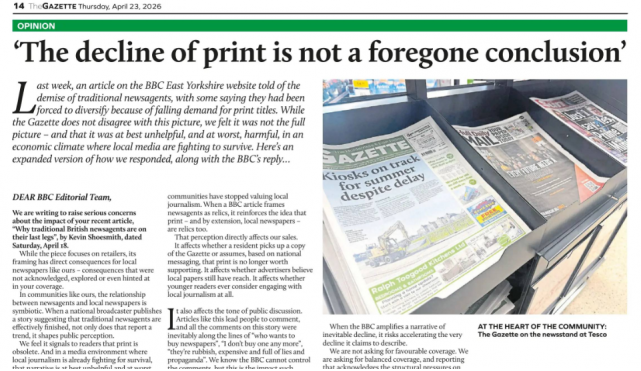
It wrote: "Last week, an article on the BBC East Yorkshire website told of the demise of traditional newsagents, with some saying they had been forced to diversify because of falling demand for print titles.
"While the Gazette does not disagree with this picture, we felt it was not the full picture – and that it was at best unhelpful, and at worst, harmful, in an economic climate where local media are fighting to survive.
"When a national broadcaster publishes a story suggesting that traditional newsagents are effectively finished, not only does that report a trend, it shapes public perception.
"We feel it signals to readers that print is obsolete. And in a media environment where local journalism is already fighting for survival, that narrative is at best unhelpful and at worst harmful.
"Your article presents decline as a foregone conclusion, yet the examples you quote tell a more complicated story. Retailers are not abandoning print because readers no longer want local news – they are being forced to diversify because of publisher-imposed margin cuts, wholesaler carriage charges and a distribution model that has steadily eroded their ability to stock newspapers profitably.
"These are structural issues, not signs that communities have stopped valuing local journalism. When a BBC article frames newsagents as relics, it reinforces the idea that print – and by extension, local newspapers – are relics too. That perception directly affects our sales.
"Local newspapers like ours operate on tight margins, serving communities that national outlets rarely cover in depth. We report on parish councils, planning decisions, school events, charity work and the everyday stories that matter to people here.
"When the BBC amplifies a narrative of inevitable decline, it risks accelerating the very decline it claims to describe.
The newspaper also published the BBC's response to the letter in which Jen Bateman, digital news editor for East Yorkshire and Lincolnshire, defended its coverage.
Wrote Jen: "The focus of the piece was specifically on newsagents and the evolution of their business models, particularly why many have diversified into convenience retail in order to remain viable. It was not an assessment of the value of local newspapers, nor a declaration that print journalism is obsolete.
"We do not accept the suggestion that a well sourced, measured BBC article would materially affect an individual’s decision to buy a local newspaper."
"While we regret if the article has caused concern, our editorial responsibility is to report accurately and in context, based on evidence and the experiences of those working in the sector.
We believe this piece met that standard and presented a fair, well sourced account of the challenges facing traditional newsagents today."
The original article quotes Hetal Patel, the president of the Federation of Independent Retailers, who cited a number of factors for the problems facing newsagents.
He said: "A decline in sales of printed news and the shift to online, along with publishers reducing profit margins and wholesalers increasing carriage charges, has meant that purely dealing in news and magazines is no longer viable for independent retailers."



