
Homelessness: How the regional press can help change the conversation
Media stories about issue often feature stereotypical images
Among my most powerful memories as a trainee reporter on a weekly newspaper is of darkness.
I would stand, spellbound, in a darkroom beneath the newsroom of the Slough, Windsor & Eton Express, watching our photographers developing their pictures. It felt almost magical to see the outlines of an image appear as they rocked the exposed paper in the developer tray.
Many years later, as a correspondent with The Times, I would sit with photographers as they showed me their images moments after clicking the shutter, using the ‘playback’ button on a digital camera.
While the technology has changed, the key point has not. As every journalist knows, powerful images are essential when projecting a story. A picture really can tell a thousand words. This being so, it’s vital that photographs - and moving images - that illustrate stories on complex social issues are chosen with care so they do so accurately.
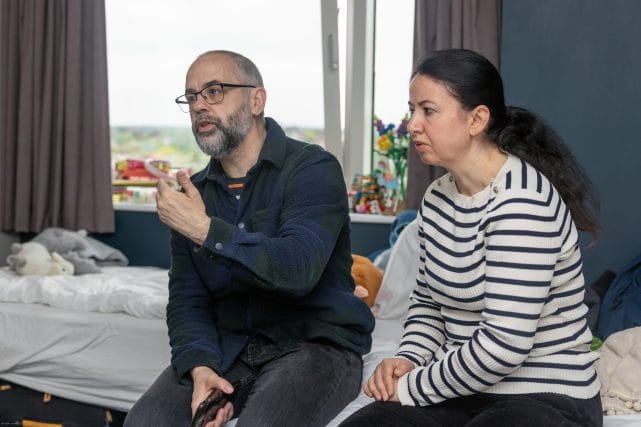
Media stories about homelessness are a particular problem.
Again and again, articles about homelessness are illustrated with variations of the same type of image. It’s an older man - always a man - slumped in a doorway in or near a sleeping bag. Sometimes there’ll be a bottle near his elbow. Sometimes a handwritten sign saying ‘homeless and hungry’ or similar. He’ll look very unwell.
And yet, as any reporter or editor who follows local authority affairs knows, the biggest challenge faced within communities is not rough sleeping. It’s family homelessness.
Regional and local newspapers, rooted as they are in the communities they represent, have an opportunity to blaze a trail by covering homelessness differently, and more accurately. I want to suggest how.
But first, some data. There were 134,210 households - not just individuals, but households - staying in temporary accommodation in England at the end of December because they are legally homeless, according to latest figures from the Ministry of Housing, Communities and Local Government (MHCLG).
Almost two thirds (63.9%) are families. They include 176,130 children. In some local authorities the spiralling cost of subsidising temporary accommodation, which housing benefit rarely covers in full, is a risk to their financial stability.
Compare this to the annual ‘rough sleeping snapshot’, which estimated that 4,793 people were sleeping on the streets on a single night in autumn 2025, also published by MHCLG.
We know this figure, based on a combination of street counts and local estimates, significantly under-represents the scale of street homelessness. And rough sleeping is without doubt the most extreme and life-shortening form of homelessness. The average age of death in England and Wales among people sleeping on the streets, or staying in hostels, is 45 among men and 43 for women, according to the Office for National Statistics.
The point holds, however. In terms of scale and cost, both human and financial, family homelessness is many times greater than rough sleeping in England. We see the same pattern in Scotland, Wales and Northern Ireland. Evidence shows that experience of homelessness in childhood is strongly associated with poorer outcomes, including poorer mental health and heightened risk of homelessness in adulthood.
At the Centre for Homelessness Impact, which is the UK’s “what works centre” for homelessness, we try to offer solutions rather than just diagnosing problems.
So we have created an open source library of almost 1,000 photographs of people experiencing homelessness, in all its forms. We’ve done it with journalists and media organisations in mind, so the photographs are free to publish and have a ‘creative commons’ copyright licence.
The pictures are ‘co-produced’ with the individuals featured; yes, we have their consent but also their active engagement in how they want their experience of homelessness to be accurately portrayed. We find that people affected by homelessness are more frustrated than anybody by the way in which this issue is so often misrepresented through images.
The way in which media images of homelessness so often revert to the stereotypal picture of a man sleeping in a doorway is a real and obstinate barrier to public understanding of the nature and prevalence of homelessness.
This misrepresentation is not intentional. During more than 30 years in journalism I’ve seen how busy researchers on a picture desk have to find images for multiple stories spanning a wide range of topics to tight deadlines, particularly for publication online. It’s easy to reach for stereotypes.
Easy, but rarely accurate. We owe it to readers and audiences to strive for the highest standards of accuracy. We owe it to hundreds of thousands of people impacted by hidden forms of homelessness to show their experiences as they really are, not how we imagine them to be.
Regional and local journalists, editors and publishers can lead the way in changing our national conversation about homelessness by thinking again how stories on this important issue are illustrated. We urge them to do so.
* Greg Hurst is Director of Communications at the Centre for Homelessness Impact.



