
Former top cop slams police after daily reveals hundreds of crimes kept secret
Force released details of just two out of 785 incidents in a fortnight

A retired police chief has hit out at his former employers after a regional daily discovered hundreds of crimes on its patch were being kept secret.
A Freedom of Information request by The Argus, Brighton, revealed that the public had been kept in the dark about 785 crimes - including rapes, robberies and kidnappings - during a fortnight-long period in March.
Other serious incidents left unreported included possession of firearms or other weapons, drugs trafficking and threats to kill.
In that same two week timeframe, Sussex Police released details about just two incidents which had taken place in Brighton and Hove.
Press releases on 114 crimes across the whole of Sussex were produced.
Now Graham Cox, pictured above left, a former detective chief superintendent in charge of Sussex CID, has hit out at the force's current relationship with the regional press in a comment piece for The Argus.
Mr Cox described how as a young detective sergeant working for Hove CID one of his daily duties was to brief the press, going on to accuse modern police communications departments of "turning out turgid press releases that then run the risk of being recycled into equally turgid news reports".
Of his past experience, he wrote: "Journalists and police officers had a working relationship, based on mutual respect and a shared understanding that each of us had a job to do.
"We took turns buying the coffee and went to each other’s office Christmas parties. We even – shock horror – shared gossip over a pint in the local 'police' pub from time to time.
"Now the police simply issue a bulletin of incidents which this week’s revelations in The Argus show cover barely 10pc of all reported crime, and missing out some of the most serious cases (rapes, robberies and assaults on police) altogether."
He also attacked the Hacked Off pressure group, which he described as 'Famous People for Censorship', adding that police had "mistakenly retreated into a bunker of secrecy and borderline paranoia where all news must be managed" in the wake of the Leveson Inquiry.
Mr Cox added: "Police officers, even whistleblowers, fear disciplinary action if they talk to a journalist. This is self-defeating for the police themselves.
"In a time of cuts to police budgets the service should be taking every opportunity to tell the public, through the local media, all the work they do. The Sussex public need a free, vibrant, independent, probing and yes sometimes irreverent local press.
"At least 200 local papers have closed in the last decade. This makes it harder for us as a society to keep local councils, police and health services on their toes, and it is creating an environment where poor service and even corruption can become routine.
"We are lucky to still have an active print media here in Brighton and Hove. Local police officers should be encouraged to talk to the journalists who call those in public service to account, and take the opportunity tell us all about the good job they do under intense pressure."
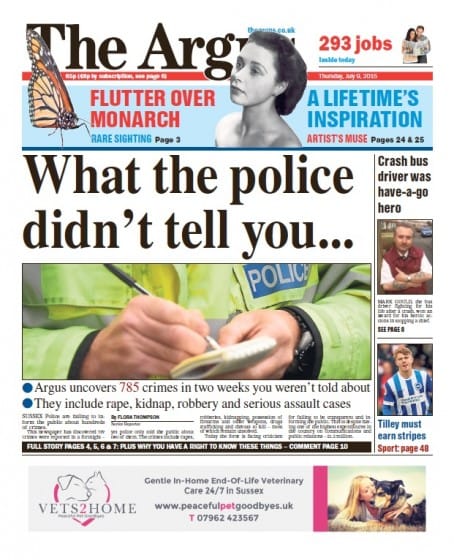
The Argus reports Sussex Police is still refusing to divulge more information about the serious crimes mentioned, despite repeated requests to its FoI department and press office.
The force's FoI officer Roger Brace told the paper more details would "require a manual search of the data base" which was "not a requirement" of the police under the law.
Society of Editors executive director Bob Satchwell told The Argus it seemed "ridiculous" the force was not prepared to tell the public about crime and suggested police were trying to prevent fear of crime.
Of the 785 crimes that were unreported, only 119 have so far been classified as solved.



