
News chief hits out at readers' 'clickbait' claims
Digital newsroom has made journalists 'more creative than ever' says editor
An editor has hit out at reader accusations over "clickbait" saying her newsroom's digital transformation has made journalists "more creative than ever."
Jacqui Merrington, who edits Cornwall Live, wrote an editorial as the county-wide news platform prepared to mark its first anniversary.
In her piece Jacqui discussed the impact that the 'Chartbeat' screen, used in a number of Trinity Mirror newsrooms to analyse reader habits online, has had on day-to-day operations.
The screen shows data on how many people are reading stories at any one time, how long they’re spending on stories, how they’re finding them and how many of them are clicking through to other content on the website.
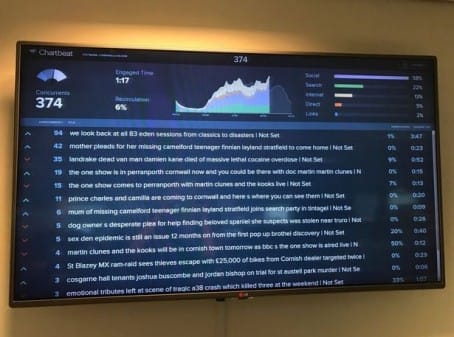
Wrote Jacqui: "It's made us more creative than we've ever been as a newsroom. We don't rely on incoming emails and phone calls and press releases and council meetings for what we do any more. That's not to say we don't do them. They're just part of the mix.
"We’re sometimes accused of writing so-called ‘clickbait’. ‘Slow news day?’ type the furious keyboard warriors on the Cornwall Live Facebook page. ‘This story is in Devon,’ adds a bright spark from the comfort of their office chair, where they should probably be working rather than worrying about the provenance of our stories. ‘This is clickbait,’ bashes out another with ill-informed abandon.
"But it’s not clickbait, To me, clickbait is intentionally over-promising or otherwise misrepresenting what you’re going to find when you read a story on the website. It’s often characterised by wording like ‘You won’t believe’ or ‘What happened next will shock you’ or ‘This is the most incredible thing you’ll see today’.
"We don’t do that. We write stories and produce content that is relevant to people in Cornwall – even if that may be in Devon - and headline it in a way that people will want to read it, without misrepresenting the story itself."
Jacqui went on to compare how headline writing online differed from the skills she was taught as a trainee.
She added: "As a trainee newspaper journalist. I was always told to start my news story with the most interesting elements of the story. Don’t give people the location in the headline, or even the first par – hook people in. Then expand on that in par 2 and 3. Then let the story unravel so the readers wants to get to the end.
"Now working for the web, the reader has to be hooked in from the social media headline, or what would have been – and still is for our print editions – the front page headline. It has to make them want to read more. Is that clickbait? No, it’s just telling a good story well.
"And good stories are at the core of what we do. The stories you read in our newspapers are still written by journalists with local knowledge, people who know their audience and who craft those stories for our websites and the newspaper because they know they’re issues that really matter to our readers."



