
Editor calls for greater female representation at ancient sporting event
News chief questions male-dominated ritual
An editor has urged the organisers of an ancient annual sporting event to give women more of a role in proceedings.
Natalie Fahy, Reach plc's editor in chief for London and the East of England, has called on those running Ashbourne's annual Royal Shrovetide Football to "do the right thing" and allow a woman to "turn up the ball", the ritual by which the game begins.
The mob football game takes place on the streets of the Derbyshire town each Shrove Tuesday and Ash Wednesday, with roots dating back to the 1660s, and is covered by the Derby Telegraph and its sister website Derbyshire Live.
In an editorial, Natalie renewed calls made by historian Trilby Shaw, who died in 2019, for greater female representation in the event.
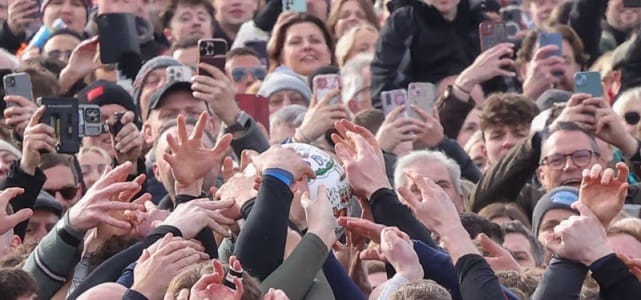
She wrote: "Why aren't we trusted to throw a ball into the crowd at the start of a football match?
"This one question bugs me year in, year out when we begin our coverage of Ashbourne's Royal Shrovetide football match on Derbyshire Live.
"For at least two days every year, the eyes of the world are on the small Derbyshire town, with thousands of people flocking there to join the sweaty hug and touch the famous hand-stitched leather ball.
"The chaos, excitement and slight terror of watching the throng move up and down the town, bashing up against boarded-up shops and windows is something not to be missed.
"But take a close look at the crowd. It's 98pc men and I wonder if women just don't feel welcome here.
"The organisers have never allowed a woman to turn up the ball at the start of the event - that is, the huge honour of throwing the ball into the crowd at the start of play each day.
"I am not the first to call this out, of course. Historian Trilby Shaw, who died in 2019 at the age of 81, spent her life campaigning for the tradition to change. It is heartbreaking to think she left this world without ever seeing a great injustice in her beloved hometown put right.
"We have to take up where Trilby left off and make sure women can be seen as equals in one of the most famous Derbyshire traditions."



