
Dyson at Large: Traditional paper still serving time-warped town
Solid stories and not a sniff of modern design says blogger
Everything about my trip to Colchester took me back in time.
The hotel where I stayed (The George on the High Street) was one of those great but ancient coaching inns with sloped ceilings, no lifts, creaking floors and erratic hot water supplies.
The pubs I found (The Hole In The Wall and The Hospital Arms) were worn but warm places where people immediately engaged you in real conversation, unhindered by tinned music or raucous crowds.
The beer was well kept (I supped Tribute Cornish Pale Ale and Adnams Southwold Bitter) and perfect for building up an appetite for a freshly cooked supper at a time-proven, flock-wallpapered venue tipped by numerous punters (chicken Ceylon at Curry-India, established 1962).
The whole of Colchester town centre – don’t worry, I’m getting to my point now – seemed stuck in the mid-1980s with its shops including at least six (maybe more, but I counted six) newsagents.
I don’t mean places that sold a few newspapers, as there were a dozen or more Spars and Tesco Express-type stores scattered around as well; I mean old shops that, in the main, sold newspapers and magazines as their primary products, along with perhaps a rack of sweets, tobacco and birthday cards.
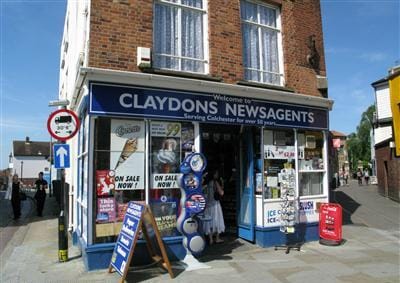
Claydons Newsagents (‘Serving Colchester for over 50 years’), N C News, Crouch Street News, Globe News, Sweet News, RJ Kay’s Newsagents – every street I turned seemed to offer me somewhere else to buy my Colchester Daily Gazette.
And so it was no surprise to find that this newspaper itself appeared set against too much change, with old-fashioned lay-out, supplements with archaic titles and good, tight news story intros.
Just look at the lay-out of the front page on Monday 28 October – not even a sniff of a modern design.
The Gazette splashed on a solid local schools story, and one that started with the kind of tight, 15-word intro that any self-respecting journalist would love: “Colchester’s secondary school crisis will be solved by creating 2,250 places, it has been revealed.”
Other news reports with spot-on headlines and well-penned intros included:
- ‘Forgotten Somme heroes like Frank finally honoured’, a local war history story leading page three, with an 18-word intro;
- ‘Relic raider ran off with our church treasure’ leading page five, a crime tale with a 16-word intro;
- ‘Jay’s step-brother: My knifeman scare’ leading page eight, a murder-related court report with a 21-word intro; and
- ‘Don’t turn Jumbo into office block’ leading page 17, a story about the town’s famous water tower with an 18-word intro.
Monday’s pull-out section was called ‘New Woman’ – a title and design that again seemed very 1980s.
But having stayed in Colchester for half a week, I reckon this traditional approach suited much of the Gazette’s audience.
And it didn’t detract from the quality of features: Esther Rantzen had joined a fight to keep a local OAP activity centre open, while other New Woman content included:- ‘When my trousers split on the dancefloor, I vowed to lose weight!’ on page 27, reporting on a local’s Slimming World diet success;
- ‘I was told I was infertile at 15... I was devastated’ on page 28, telling how a woman ended up defying doctors’ predictions; and
- ‘Sock it to them with a big bun’ on page 29, a ‘how to...’ hairstyle feature with a step-by-step guide in pictures.
In total, there were 175-plus stories on 42 news, features and sports pages in a 48-page book – not a bad story count, despite a rather steep 65p cover price.
I wonder how much this cost has hit sales at the Newsquest-owned Daily Gazette, its last ABC for the first six months of 2013 recording a -15.5pc drop to an average of 12,889 copies a day.
Longstanding editor Martin McNeill retires at the start of next year, and his replacement will face the age-old dilemma: modernise and relaunch to attract new readers and slow the decline, or move carefully so as not to offend the hard core of traditional readers the paper still has.
He or she will decide well, I'm sure, but I’d advise a gradual approach – this is an old town, not a cosmopolitan city – with developments that don’t lose the decent content, capable writing and high editorial ratio that McNeill has instilled.





