
Dyson at Large: Newest weekly must get to grips with its name
HTFP blogger reviews the latest regional daily to go weekly
WARNING: If you dislike pedants, please don’t read this week’s blog.
But just what is the UK’s newest daily-turned-weekly newspaper called?
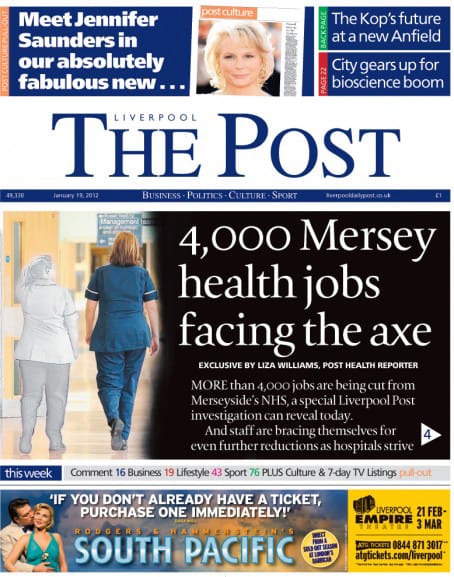
According to the masthead, it’s ‘The Liverpool Post’ with a huge visual emphasis on ‘The’...

This new masthead doesn’t read too well though, does it? The natural way to say what you see is ‘Liverpool The Post’, before you realise the words are meant to flow the other way round.
Compare this stumbling effect to the old daily masthead which read clearly the way it should as ‘Liverpool Daily Post’...

At least the new masthead uses size to select two important words that might be the way the paper has always been referred to locally – simply ‘The Post’.
Not that this works if you’re a regular online reader, because on the internet the masthead on all the title’s pages is still Liverpool Daily Post, and this means any references to the paper carry the old name.
This maintenance of the old masthead online is deliberate, of course, indicating to readers that there is still a ‘daily’ web news service available to complement the new weekly newspaper.
But I think it’s a mistaken strategy to relaunch the paper as ‘The Liverpool Post’ then not to reinforce this name as the website, which is clearly where most long-term marketing is going to take place.
It’s also confusing to the eye, like on this web page where, at the time of writing, you see both ‘The Liverpool Post’ and the ‘Liverpool Daily Post’ mastheads, and then ‘Liverpool Post’ in the headline (the latter with no ‘The’ or ‘Daily’).
This gets worse in print, with at least seven different examples of the newspaper’s brand referred to in the launch edition on 19 January:
- ‘The Liverpool Post’ is the page one masthead;
- ‘www.liverpooldailypost.co.uk’ is the web address immediately underneath that masthead;
- ‘Liverpool Post’ is in the first par of the splash on page one, also in the address to write to with complaints on page two, and in the editor’s welcome letter on page three (not using ‘The’);
- ‘Liverpool Daily Post’ is the old image used for the paper’s ‘Get On Board’ campaign logo on page 15;
- ‘The Post’ is the title above the paper’s editorial leader column on page 16 (no ‘Liverpool’);
- ‘letters@dailypost.co.uk’ is the email address for letters on page 17;
- ‘Liverpool Post’ is in the address on page 17 (no 'The');
- ‘The Post’ comes before the news desk numbers for readers to call and fax, also on page 17;
- ‘liverpooldailypost’ is within the url address for the paper’s online comment forum, again on that changing list on page 17;
- ‘Post’ as a single word is in every byline reference throughout the paper, as in ‘Post Health Reporter’, and in all section heads, as in ‘Post Sport’, ‘Post Culture’, and so on, (not using ‘The’ or ‘Liverpool’); and
- it's back to the full ‘The Liverpool Post’ title on all official advertising references throughout the classified section, for example on all the Reader Holiday house ads.
The paper cannot, of course, use the same long title throughout, but it can and should be properly abbreviated – ‘The Liverpool Post’ becoming ‘The Post’, not bastardised to ‘Liverpool Post’ or ‘Post’ and constantly referring back to the ‘Daily’ online brand.
Or perhaps it would have been less confusing not to involve the 'The', simply taking the ‘Daily’ out of the old title to create ‘Liverpool Post’ in the new masthead. But by making such a big visual decision on ‘The’ atop the new front page this is not the case.
For The Liverpool Post to become firmly established as a well-known weekly newspaper, I feel it must decide what it’s called in full and what it can then be referred to in short, making sure that every sub understands this style rule and applies it consistently in print and online.
Enough pedantry. What about the content of the new weekly?
I was impressed with the strong investigative splash on 4,000 local NHS jobs that could go by 2014, and appreciated the space given to the detail on pages four and five.
Less likeable was the mish-mash of picture boosts on page two and then the hard-to-decipher ‘look back’ and ‘look ahead’ sections on page three.
There was a lack of strong news leads on other early pages – page six led on a councillor’s retirement, page seven on proposed cuts to automatic fire alarm responses, page nine was comment and pages ten and eleven contained a soft business interview headlined ‘Bob the builder is a man with a plan’.
The 18-page news section contained just 17 actual news reports, the other 39 stories being comment, diary or letters, an imbalance that should quickly be addressed.
The ‘Post Business’ section from page 19 was more satisfying: there were 61 stories on 21 pages and 51 of these were news reports. But this strength was diluted by then turning into another 12 pages of ‘Post Lifestyle’ which, despite a reasonable mix of fashion, food and drink, travel and puzzles, just didn’t gel well with business.
Much, much better was ‘Post Culture’, a 24-page pull-out fizzing with well-scribed interviews with the likes of Jennifer Saunders, thoughtful local reviews and detailed listings. And ‘Post Sport’ was a decent read, thanks to the efforts of Ian Doyle who wrote more than half its 13 pages.
Overall, the content was good enough and will soon get better as skilled writers and editors get used to grappling with a 112-page paper, rather than what used to be a slim daily.
Let’s just hope the branding becomes more decisive.



