
Dyson at Large: Front page lacked a good read
Design 'allowed to dominate to detriment of story' says blogger
The Newcastle Chronicle’s splash on Saturday 17 January was ‘LAWLESS’ – reflecting how the city’s sexual offences were up 186%, assaults up 31% and robberies up 24%.
This became a decent and detailed article on pages two and three, but was reduced to a shouty, white-on-black design on the front – not only the main headline, but also the statistics – with nothing to read apart from an 18-word write-off that looked like a sub-heading.
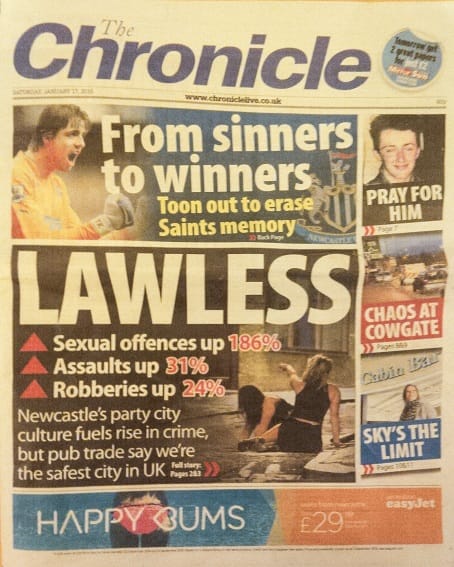
Whatever happened to the idea of giving readers something to get stuck into on page one, as well as the headlines, then turning to the full stories inside?
The rest of the Chronicle’s front was also obsessed with multiple WoB headings: ‘From saints to sinners’; ‘PRAY FOR HIM’; ‘CHAOS AT COWGATE’; and ‘SKY’S THE LIMIT’.
Chronicle editor Darren Thwaites is a sound operator, and so perhaps he and his team have been told by audience research that this is what readers want.
It certainly feels like a decided change from the days when the Chronicle’s fronts were more often than not headlines, pictures and at least the beginnings of stories, with a second lead also starting on page one.
There are, of course, moments when nothing else but a poster-style splash will do, and one of the best regional fronts of 2014 was the Chronicle’s campaigning ‘P45DUE’ in April, which suggested it was time for Newcastle United’s Alan Pardew to go.
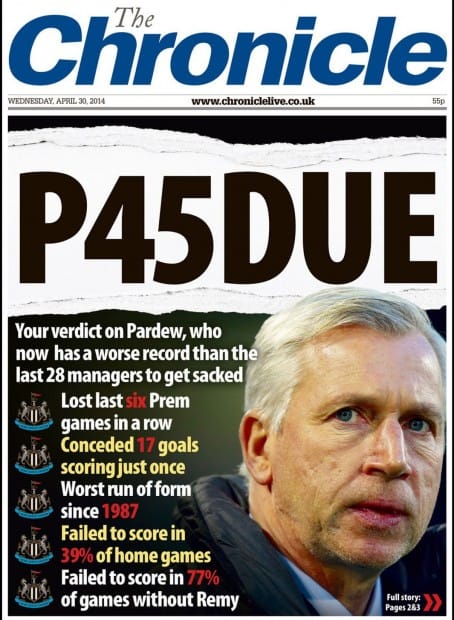
This was a fantastic idea, superb design and something that would have gotten fervent Magpie supporters’ juices going – as well as making Pardew himself and the club think about what soon became fact.
But if papers bludgeon readers too often with huge headlines and bullet-point lists bleeding across blown-up pictures, are they not in danger of anaesthetising the instinct to pause, read and buy?
That debate aside, there were some strong and informative news stories inside the Chronicle, with upper and lower case headlines in restrained font sizes that allowed the copy to breathe at respectable lengths, including:
- ‘People power saves ice rink from the bulldozers’ leading page four;
- ‘More traffic disruption as Cowgate work begins’ leading pages eight and nine;
- ‘We’re doing so well we could soon outgrow our shipping container’ leading page 17, reporting on a booming brewery;
- ‘And you thought life was tough out there already’ leading page 20, on the latest cuts to children’s services; and
- ‘Rat stole from man he was looking after’ leading page 27.
However, there were too many other page leads where design and pictures were allowed to dominate to the detriment of the story, including:
- ‘David Ginola VS Sepp Blatter’ filling page six, when a montage of headline, picture and basic statistics unnecessarily filled four-fifths of the page;
- ‘A fuller flavour of the North East for airport’ spread across pages 10 and 11 with no fewer than seven pictures, five of them fairly meaningless scenes, dishes or rows of bottles;
- ‘Time is called on pub landlord and brewer’ leading page 12 – a good story but seemingly crammed in by three pictures taking up two-thirds of the page, including a quarter-page pint pot; and
- ‘The six month anniversary has just crept up on us all’ leading page 14, another interesting read once you got down to it, but with two huge pictures of the same man, including one where his black coat filled a fifth of the page.
Anonymous comments may soon appear underneath this blog, outraged that a former regional editor can bring himself to criticise when so few staff are doing such a sterling job at bringing out papers at all.
And, of course, it should be acknowledged that times have changed, ranks of subs desks have gone, templates have been introduced and yet deadlines still have to be met.
That said, the conscientious hacks up in Groat Market putting the Chronicle together will want to occasionally reflect on the product, which is the only way to keep standards as high as possible.
This is crucial at a time when the industry is striving to make headway online, because no-one knows exactly when (or even if) digital revenue trickles will become torrents, and it would therefore be madness to kill the golden goose of print too quickly.
The Chronicle’s story-count was 300-odd reads on 77 editorial pages in an 88-page book, which made the 60p cover price feel like good value.
Owned by Trinity Mirror, the paper sold an average of 34,954 copies a day in December 2014, down 11.4pc on the same month in 2013.



