
Dyson at Large: Don't use corny clichés in headlines
Weekly front page makes blogger groan out loud
Let’s get my main gripe out of the way: local newspapers must try harder to avoid corny headlines, especially on page one.
‘ALL ABOARD’ was the splash for the Batley & Birstall News on Thursday October 9 2014, and it made me groan out loud.
Those two words might just have worked as part of a sub-heading, such as ‘Locals are all aboard for station revamp’, or they could have been used to introduce the caption, or they might even have headlined a picture story that showed people boarding a train.
But a splash headline needs to be much more active and meaningful, such as ‘Let’s repair our station’, or ‘Batley needs a new station’, not reminiscent of some Victorian controller’s bellow in the days before public announcement systems.
What’s worse is that this ‘ALL ABOARD’ takes up less than half the width of page one, and almost feels part of the ‘£10 rail offer’ boost as the eye wanders to find a focus.
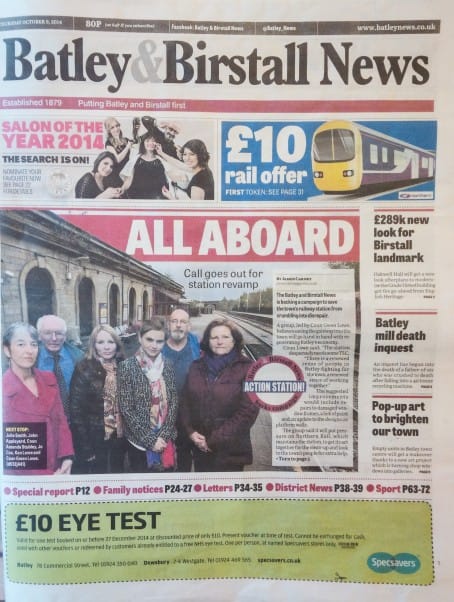
Put simply, ‘ALL ABOARD’ is a hackneyed phrase that’s empty of meaning, dull and pointless, the sort of cliché that local papers use too often.
Instead, journalists should remember to think subject, verb, object, and try to tell readers exactly who's doing what to who, starting with headlines and continuing with simple language throughout stories.
Which is where I get to my next whinge: the jargon that remained in this story was sloppy.
Try this from the second paragraph of the write-off on page one: “A group, led by Coun Gwen Lowe, believes that saving the gateway into the town will go hand in hand with regenerating Batley’s economy.”
Using an indirect quote means paraphrasing into plain English, not just deleting the speech marks but using the same gobbledegook anyway.
More obscure words appeared in the introduction of the main story on page five: “A new era for Batley Railway Station would run in parallel to the regeneration of commerce in the town according to a new action group.”
Eh? Is that the way you’d talk to your mate in the pub? If it is, you’d soon be left standing.
It sounds to me too much like copying and pasting what was sent in on the press release, rather than challenging every sentence and word to make sure they are right for your readers.
The story subject itself, by the way, was fine: Batley’s crumbling station needs repairing, and a group of worthy locals is calling on everyone to get involved.
Moving on, there were other decent stories – and mainly active headlines – in the News that week, including: ‘Governors face the axe at Bruntcliffe’ leading page four; ‘Taxi drivers’ solidarity with executed hostage’ leading page seven; ‘Grit services face winter cutbacks’ leading page 16; and ‘New head shares vision’ on page 18.
But other headlines lacked that final touch of finesse, such as: ‘UK Greetings to stop making cards here’ leading page eight (where? ‘in town’ would have done); ‘Caring our lives away?’ leading the spread about stressed carers on pages 12 and 13 (the words worked, but the question mark wasn’t needed); and ‘A&E among best performing’ leading page 14 (the last word left space for six letters on the second line, so why not add ‘in UK’?)
Am I being too picky? Perhaps, but newspapers are about using words that clearly explain stories, so why not spend a few more minutes studying the proofs and taking advantage of every space?
Pleasingly, better attention was paid to lively shorts, including: ‘Moped driver injured in crash’ and ‘Tax cheat jailed’ on page three; ‘Thief disturbs breakfast time’ and ‘Festival winners are announced’ on page five; ‘New panel formed to fight child sex abuse’ on page six; and ‘Strike to hit bin collections’ on page 11.
More praise is due for the hard-working ‘Reports from the courts’ section on page 14, packing in 31 detailed convictions in a quarter page of small point, and for the traditional but interesting ‘Planning applications’ on page 16, this time squeezing in 41 cases under the useful sub-headings of ‘Received’, ‘Approved’, ‘Withdrawn’, ‘Not required’ and ‘Invalid’.
And while it’s not strictly editorial, a busy ‘Family announcements’ section always speaks volumes about a newspaper’s local worth, and so it was good to see three pages of obituaries, acknowledgements and birthday memories.
But the real gem in the paper was the best piece of user-generated content I’ve seen for a long time: a ‘Head Lines’ column written by Jonny Mitchell, the straight-talking headteacher from Thornhill Community Academy, star of Channel 4’s Educating Yorkshire.
The Batley & Birstall News is part of the ‘Reporter series’ owned by Johnston Press, and the Thornhill school actually lies in nearby Dewsbury, home of sister paper Dewsbury Reporter, which also carried the column.
But that’s no matter: Mr Mitchell’s first person piece – this week headlined ‘I’d rather be a myth buster than gullible!’ – was a good enough read to appear in any Yorkshire paper, and whoever signed him up should be very satisfied.
The 72-page News, with an extra 16-page ‘Property’ section, costs 80p (64p for subscribers) and was selling an average of 4,908 copies a week in 2013.



