
Dyson at Large: A much-loved maverick's last Post
As Midlands weekly bids farewelll, our blogger reviews the final two editions
Carefully read the following intro to a front page lead. Savour it, chew it over. And then try telling me you don’t just love it.
“As anaemic morning sunlight struggled to make an impression on the damp, drab Cannock street – made even more bleak by the sodium street lighting that cast dancing, fire-fly shapes in puddles – they hit hard and fast.”
Such prose breaks various basic news-writing rules, and is more like the first paragraph of a novel by George Orwell than the splash intro for a free weekly newspaper.
But I personally found it gripping when reading the Thursday 10 November edition of the Chase Post.
The story was an ordinary dawn police raid on a drugs den, and we’ve all either penned or edited dozens of these, mainly nosed something like: “Three men were cautioned for drugs offences after a dawn raid by 25 police on an Oxdown estate.”
Chase Post editor Mike Lockley, however, is no ordinary journalist.
His story continued: “The barked commands, the thuds, the sound of shattered glass, the screams of protest, cut through the cold morning air, causing families to fling open their windows and stare at the carnage below.
“Cannock police – all 25 of them – were publicly drawing a thorn from the side of this community: a thorn that has been allowed to fester for years. Within the blink of an eye, they hit – and disabled – addresses in Mill Street suspected of harbouring a crack cocaine trade.”
Yes, it was long, and yes, there were copious superlatives. But boy, did it entice me to read on, supplying answers to all the Ws by the end of those first four sentences.
In total, there were 26 paragraphs across the page two and three spread where this story was laid out, and each one was a delicately crafted and therefore compelling par.
This is the type of reporting that Lockley has served up to Cannock readers throughout his 25 years – yes, 25 years – as editor of the Post. (Holdthefrontpage reported on this earlier this month.)
Even the page one design – which only had an awkward, squeezed T-space between ads for a headline, picture and first few pars or sub-heading – instantly told any reader that this was a story that was going to speak for the way they felt.
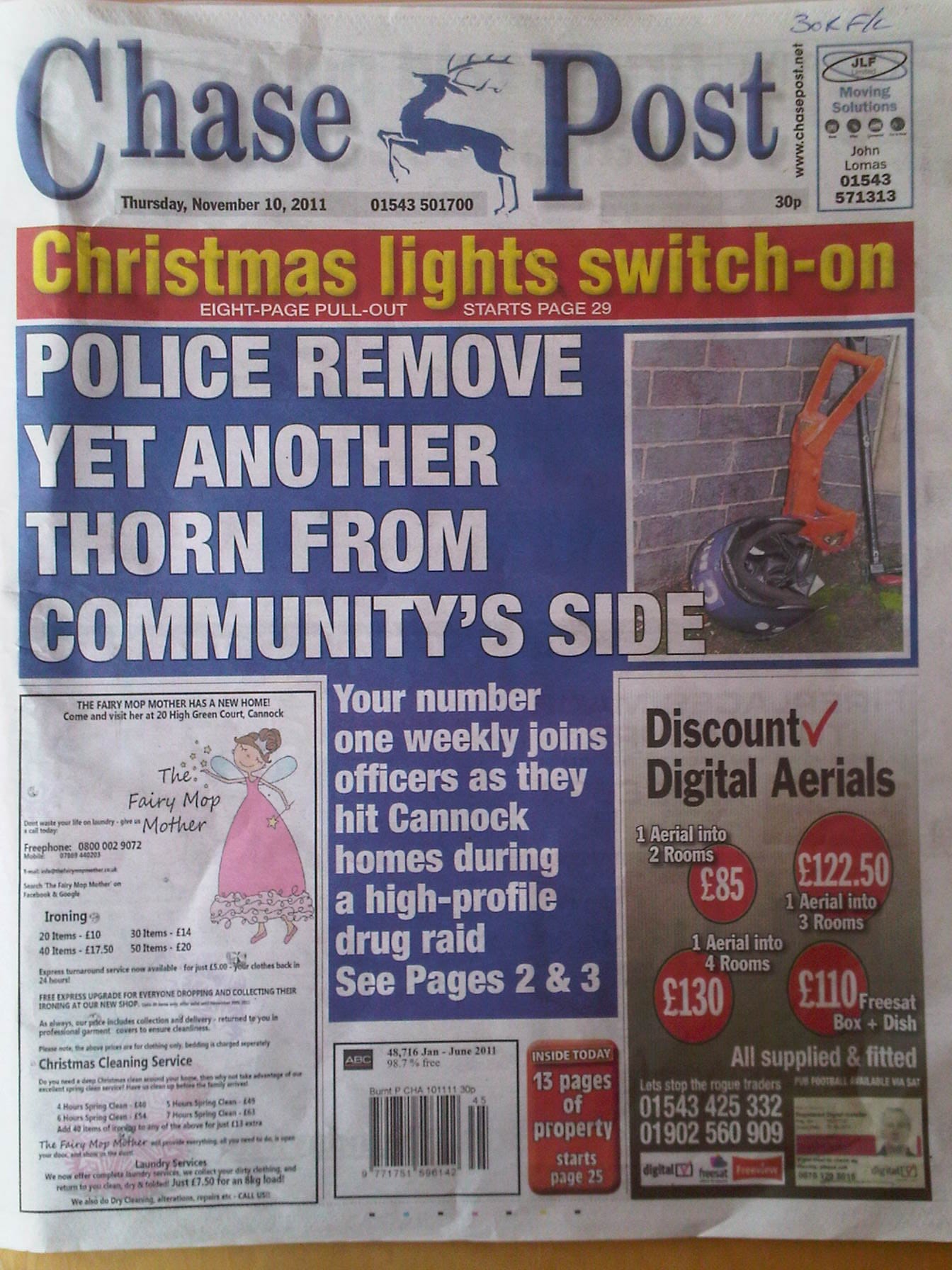
‘POLICE REMOVE YET ANOTHER THORN FROM COMMUNITY’S SIDE’ was the kind of headline that would have had residents nodding their heads and turning to the story as soon as they picked up this paper from the doormat. How many free weekly newspapers do that to readers these days?
Not that the Chase Post itself will be doing so any more – the paper's closure along with the Stafford Post and Sutton News was announced last week by Trinity Mirror.
I selected the penultimate Post for today’s review because I thought it fairer to do that than scrutinise the actual final edition – although I will also take a peek at that towards the end of this blog.
In a 64-page paper on 10 November, there were 22 editorial pages – some of them ‘postage stamps’ because of ads – containing a total of 85 stories on news, sport and features.
‘Olympic torch bombshell a flamin’ liberty for the region’ was the lead across pages four and five, by reporter Charlotte Paxton, reporting on fury at news that Cannock Chase Council had not expressed an interest in hosting the torch.
Pages seven and nine both led on fascinating reports from Cannock Coroners court – a depressed family man who committed suicide by setting his mobile home alight, and a pensioner possibly distracted by eating chocolate before fatally stepping in front of a motorcycle.
Quite how well the Coroners and other courts and council matters will be covered from now on remains to be seen.
The Cannock & Rugeley Chronicle free weekly still exists, although I understand this is filled with content ‘owned’ by its parent Wolverhampton Express and Star daily rather than having its own dedicated news team.
And the Chronicle certainly has no columnists who start pieces like this: “Whisper it, but sharing a bed with my wife, whose body thermostat is now malfunctioning due to the menopause, has become a trial. I know we pledged to stay together through thick and thin, richer and poorer, but the vicar said nothing about hotter and colder. Nobody did.”
Yep, that was Lockley again, this time on page 10 of the Post in his ‘It’s a lighter look at life...’ column that’s so consistently good it’s syndicated across sister weeklies, with a separate, award-winning version appearing in the Sunday Mercury. Let’s hope that survives the latest cull.
On the subject of culling, my particular interest on 10 November was counting the ads to try to understand why Trinity Mirror felt the Chase Post had to go. And, to start with, I was furiously scratching my head.
There were 67 display ads, many of them quarter, half and full pages, 14 classified pages crammed with hundreds of small ads and 13 pages of property parading 250+ homes from 13 estate agents.
The value of any local newspaper can also be judged by the popularity of its Family Announcements section, and the Post carried 50+ ads in a BMDs section that spilled onto three pages.
The above sounds like a hell of a pile of ad revenue to give up on – and a whole lot of community spirit to squander.
But when I discussed all this with two very senior Trinity Mirror sources, four points emerged that perhaps made the decision less questionable.
Point one: we all know that advertising has been hit by the recession, which means the number of ads bought and their frequency are declining anyway.
Point two: the vast majority of Post advertisers were also very local, which means they would be mainly buying ‘low yield’ ads – or cheap and cheerful to you and me.
Point three: in a recent tour of regional sites, Trinity Mirror finance chief Vijay Vaghela was said to have revealed a 28% increase in newsprint costs in 2011 – with each percentage point costing the group around a million pounds.
Point four: This scenario is severely damaging to the profit margins of any free newspaper with no cover price to fall back on, and in the case of the Post my source claims it was making heavy losses.
None of this makes a much-loved paper's closure any easier to swallow, especially when according to the latest ABCs the Post was delivered free to 48,716 homes.
And so it was good to see Lockley’s endearing habits displayed once again on 17 November with a final front page message to Post readers that began clearly and warmly: “Don’t know how to break this, but... This is the very last Post.”
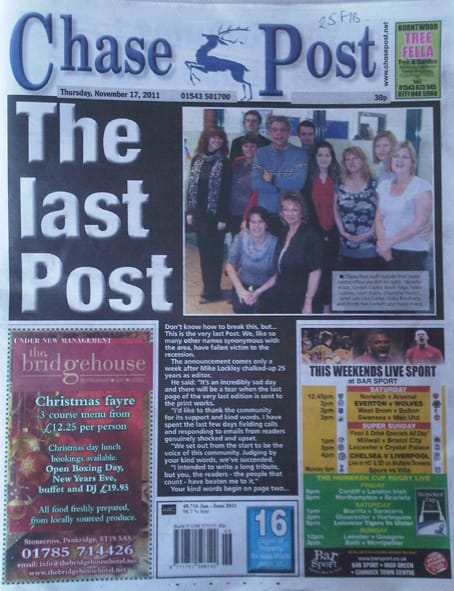
This was followed by five pages of 50+ tributes that flooded in during the closure week – messages sent by everybody from ordinary readers to politicians, and from police chiefs to rock stars like Glenn Hughes of Deep Purple.
But it was Lockley who best summed up how everyone was feeling as his page one message continued: “We set out from the start to be the voice of this community. Judging by your kind words, we’ve succeeded. I intended to write a long tribute but you, the readers – the people that count – have beaten me to it.”
We can only hope that someone, somewhere – perhaps without huge central costs and with no plc shareholders to please – might take a long, hard look at whether a locally owned Post with its great staff might still work.



