
Daily plays 'key part' in snaring terrorist who planted homemade bomb
Email claiming responsibility for crime was sent to newspaper
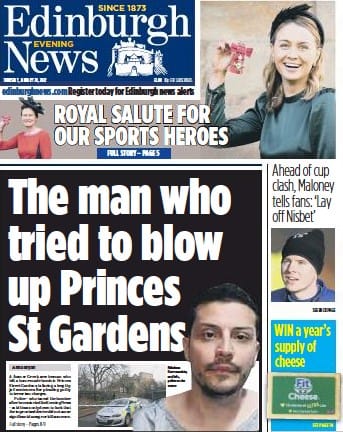
A terrorist who planted a homemade bomb in a tourist hotspot is now safely behind bars thanks to a city daily.
The Edinburgh Evening News has revealed its part in capturing Nikolaos Karvounakis after he claimed responsibility for planting the bomb in an email to the newspaper.
The device was found on 11 January 2018 in Edinburgh's Princes Street Gardens and Karvounakis contacting the EEN about a month later.
The email was headed 'International Terrorist Group in UK' and contained a single line written entirely in capital letters: "International terrorist group 'ITS', claim responsability [sic] to Edinburgh bomb."
Subsequent enquiries by the paper revealed the organisation to be a Mexican eco-terror group and the EEN contacted Police Scotland for a comment.
In response, a call came direct to editor Euan McGrory's office, asking whether he would be willing to meet a senior counter-terrorism officer the following day.
The email became a "key part in the investigation" to trace Karvounakis, who pleaded guilty on Wednesday to being in possession of items for a terrorist purpose at the High court in Edinburgh.
In an editorial revealing his paper's part in securing the conviction, Euan said he had been "sceptical" about the email when he was first made aware of it and believed it to be "the work of a crank".
Wrote Euan: "We simply didn’t know what to make of it, so we did what we are paid to do, and made some inquiries.
"There was little evidence of the International Terrorist Mafia which was claiming responsibility, but there were other references to the existence of a self-proclaimed “eco-terrorist” group going by that name.
"It was intriguing, but we did not know how seriously to take it."
At that point, the EEN contacted the police to "ask if they could shed any light".
Added Euan: "What happened next was unusual. The return call came a few hours later, not to the newsroom, but direct to the editor’s office, asking whether I would be willing to meet a senior counter-terrorism officer the following day and agree to postpone any plans to publish any details of what we had been sent until after that. I agreed.
"The next day, the officer travelled through to our Edinburgh office and sat down with me over a cup of coffee to explain that he and his officers were taking this extremely seriously.
"They believed then, as they do now, that this was a genuine act of terrorism and that this lead, coupled with what they already knew was potentially leading them to the person or people responsible.
"Publishing any details would put his investigation at risk at a delicate stage and could lead to a terrorist going free.
"Was he just telling me that to make his life easier or was there a genuine risk of a terrorist evading justice It was impossible for me to tell.
"What could I do? Of course I agreed, I wasn’t going to take any chance in the circumstances.
"Officers checked our computers and took away electronic copies of the message. In the end, it was a key part in the investigation which led to would-be bomber Nikolaos Karvounakis being traced and apprehended.
"Sometimes those weird emails turn out to be far more important than you would ever imagine."
Advocate depute Angela Gray, prosecuting, told the court on Wednesday that the bomb, which contained 58 nails, would have "the potential to cause significant injury to persons and damage to property in close proximity" if it had detonated.
John Scullion, defending, said: "The accused's position is he intended to cause disruption but not physical harm and when the device was left in the gardens it was not set to detonate."
Karvounakis, 35, was remanded in custody ahead of sentencing next month.



